
Summary of Emissions of Agriculture and Livestock
Global Impact
Agriculture contributes approximately 25% of all greenhouse gas (GHG) emissions:
- 80% of agricultural emissions come from animal agriculture products (meat, milk, eggs)
- Livestock production accounts for 70% of all agricultural land and 30% of the land surface
(Source: Mulvaney 2020, p. 218 f.)
Key Statistics from “The Game Changers”
-
Egg, fish, meat, and dairy farming require 80% of farmland but only provide 18% of the world’s calories (Source: Poore et al, Science 360(6392)987-92) (#visualization-idea)
- In the United States, farm animals produce 50 times more waste than the US population
- Up to 1/3 of animal products is wasted
From Our World in Data
https://ourworldindata.org/global-land-for-agriculture

Statistic from @Kqed
- Excluding human biomass, 94% of mammal biomass on Earth is livestock
- I created a visual for this KQED image at 🔮 MMSMammalWeight-A.

Related Resources
- See 🔮 SEEDS-A for information on low crop diversity in agriculture
- Check 🔮 MMSMeatStickA for an in-progress sticker project addressing ethical neglect of animal rights
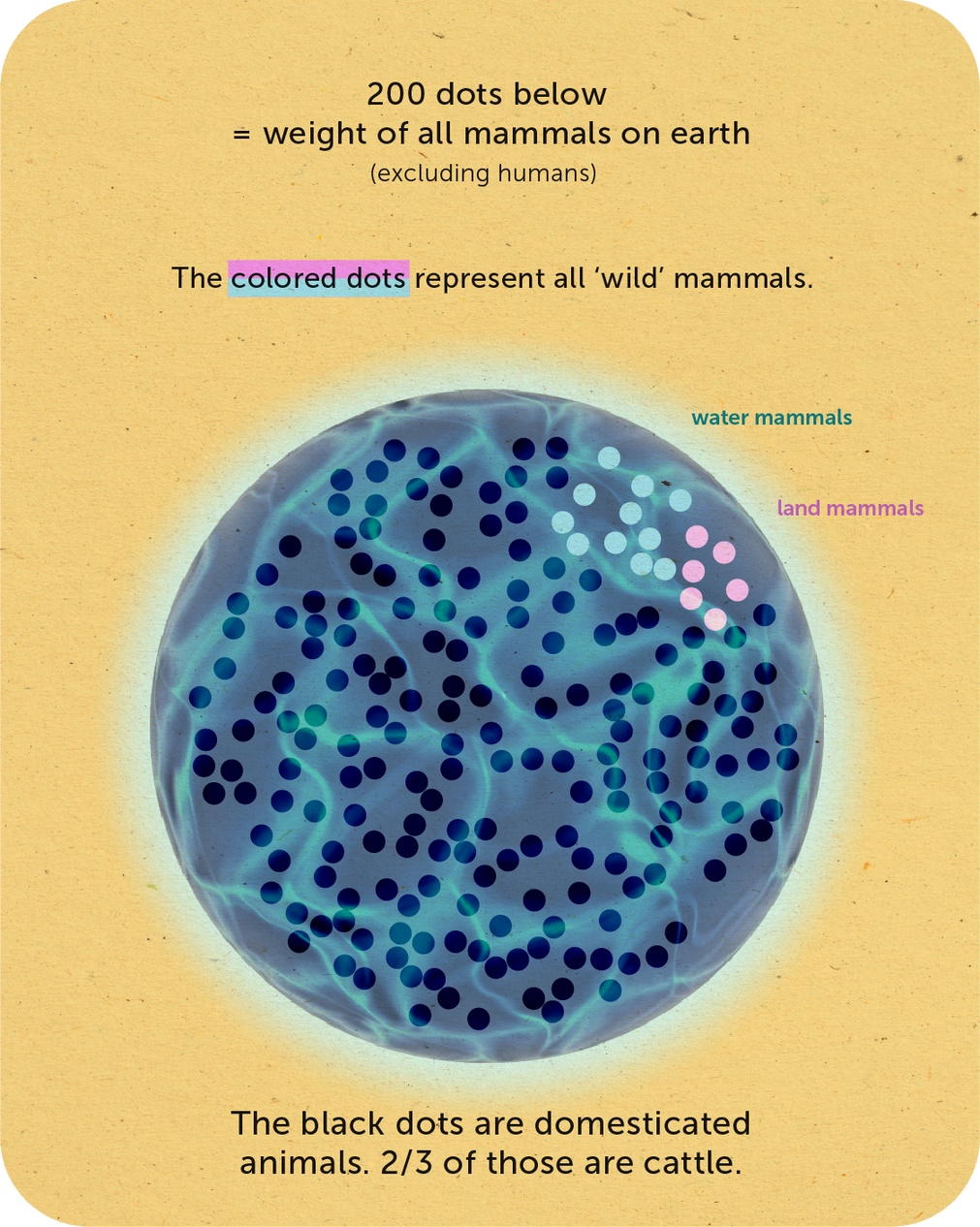
Visualizing the ratio of wild mammals to domesticated mammals
This visual was inspired by a statistic I couldn't believe at first: The vast majority of mammals that live around humans is domesticated and used for human consumption. Only a small fraction of all the mammals around humans lives a "free" or "wild" life. Disclaimer for the graphic: I know...
#agriculture #livestock
References
Mulvaney, D. (2020). Sustainable Energy Transitions: Socio-Ecological Dimensions of Decarbonization (1st ed. 2020, p. 258). Palgrave Macmillan.
~ •• • •• ~
Does something bubble up for you?
Pin your ideas or thoughts here 📌
No sign up required. Just provide your email.
License for all original work:
